
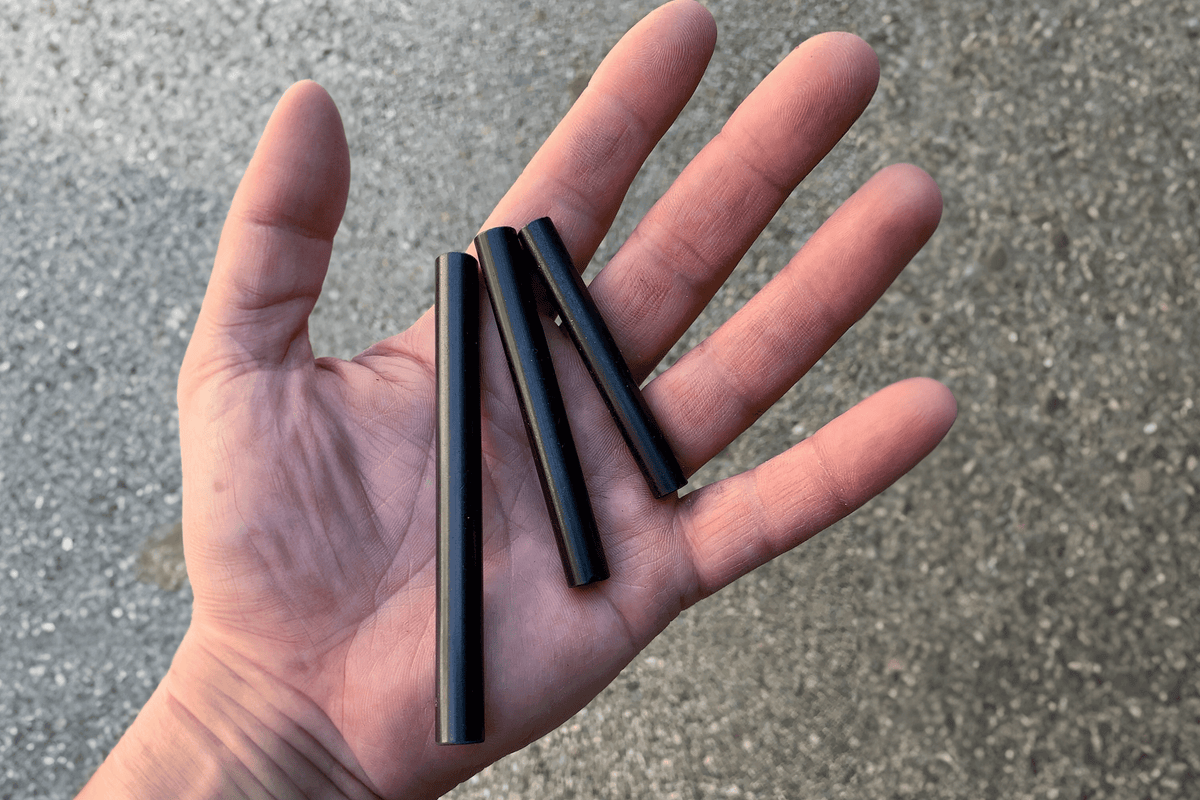
The history of ferrocerium from 1903 and its evolution into modern fire starters.
Introduction to Ferrocerium: The Spark of Modern Fire Starting
Most fire starters share one essential element: the flint that generates a hot spark. Over the years, this substance has been known by various names—Auermetall, Mischmetal, and Ferrocerium are among the official terms, while everyday usage includes ferro rod, fire steel, or simply flint.
Ferrocerium is the modern name, combining "ferro" (Latin for iron) and "cerium" (a rare earth metal). Rare earth metals, despite the name, are not particularly scarce; the term arose from the historical difficulty in extracting and separating them from surrounding materials.
Carl Auer von Welsbach: The Inventor and His Breakthrough
The story of ferrocerium begins in Austria at the turn of the 20th century. In 1903, Austrian chemist Carl Auer von Welsbach invented the alloy while researching rare earth elements and improving gas lamp mantles (mantles are still used today in portable camping lanterns - e.g., Coleman or Primus pressure lanterns).
He patented a pyrophoric (spark-producing) composition that year, creating what he called Auermetall—a name derived from his middle name "Auer" combined with "metall."
This discovery built on von Welsbach's earlier work with rare earths, including the separation of elements like praseodymium and neodymium in 1885. By purifying cerium and alloying it with iron, he developed a material that reliably produced hot sparks when struck or abraded. For more on his life and contributions, see the Wikipedia page on Carl Auer von Welsbach or Britannica's biography.
The Establishment of Ferrocerium Production in Austria
In 1907, von Welsbach founded operations in Althofen, Austria, to produce ferrocerium on a commercial scale. This small town became the hub for manufacturing, and production has continued in the region for over a century. The Treibacher Chemische Werke (later Treibacher Industrie AG) carried forward the legacy, making Austria the longstanding center of ferrocerium expertise.
The invention quickly found applications in early cigarette lighters and portable fire starters, revolutionizing reliable ignition in everyday and outdoor use.
Composition of Ferrocerium: The Role of Cerium and Lanthanum
A high-quality ferro rod typically consists of:
- 76% rare earth metals — primarily cerium and lanthanum (essential for generating intense, hot sparks through pyrophoric reaction)
- 20% iron (provides structural hardness and durability)
- 2% magnesium (enhances spark volume and ignition ease)
- 2% other materials (for surface treatment and corrosion resistance)
Cerium and lanthanum dominate the rare earth portion, enabling the alloy to produce sparks reaching up to 5500°F when struck. The exact balance between hardness (higher iron) and spark intensity (higher rare earths) determines performance—too soft wears quickly, too hard reduces spark output.
A well-balanced ferro rod offers thousands of reliable strikes with a wide, hot spark spray, making it ideal for consistent fire starting.

Evolution of Ferrocerium and Enduring Significance
Since its invention in 1903 and factory establishment in 1907, ferrocerium has evolved with advancements in alloy consistency and manufacturing. By 2016, improvements in processing further enhanced spark reliability, surface quality, and resistance to corrosion.
Today, ferrocerium remains a cornerstone of modern fire starters, from lighters to survival tools. Its Austrian origins highlight a legacy of innovation in chemistry and practical application.
Explore Ferrocerium in Action
Discover premium ferro rod fire starters inspired by this history, including waterproof models with high-quality Austrian ferrocerium.
All Fire-Fast fire starters use Austrian ferrocerium.
Check out the entire line of fire starting tools that combine this top-tier flint with durable, custom designs.
Additional Reading
Von Welsbach's Pivotal Role in the Modern World
Carl Auer von Welsbach (1858–1929) was extraordinarily influential, bridging chemistry, invention, and industry. His key contributions include the gas mantle (1885), boosting gas lamp brightness 5-10x and illuminating cities pre-electricity; osmium filament bulbs (1898), paving the way for modern light bulbs; and ferrocerium (1903), foundational for lighters and survival tools. He also provided pure rare earth samples to physicists like Planck and Bohr, aiding atomic theory development. Without him, advancements in lighting, electronics, and quantum research might have lagged.
Early Fire Starting Tools with Ferrocerium
Ferrocerium's early applications (post-1903) included pyrophoric lighters (wheel or striker mechanisms, replacing flint-and-steel), gas jet strikers for lamps/torches, and welding igniters for industrial safety. These were commercialized by 1907, evolving into widespread cigarette lighters and portable survival flints.
Original Ferrocerium Composition
Von Welsbach's original 1903 ferrocerium was approximately 70% rare earth metals (mainly cerium) and 30% iron, designed for friction-based sparking at low temperatures. It was later refined with lanthanum, magnesium, and anti-corrosion additives for modern use.
Praseodymium and Neodymium: Discovery and Uses
In 1885, von Welsbach separated praseodymium and neodymium from didymium using fractional crystallization. At the time, they had scientific interest and limited uses in glass coloring (praseodymium for green hues, neodymium for pink/violet) and early gas mantles. Today, neodymium powers NdFeB magnets in EVs, wind turbines, and electronics; praseodymium enhances magnet stability in aircraft alloys, lasers, and UV glass. This 1885 work honed separation techniques crucial for ferrocerium's development.
Rare Earth Extraction Methods: Timeline and Process
Rare earth discoveries began in 1787 (yttria) and 1794 (cerite), with extractions evolving over ~150 years: early 1800s (fractional precipitation), 1885 (von Welsbach's multi-step fractional crystallization—often hundreds/thousands of iterations, 1940s (ion exchange), and 1960s (solvent extraction). Von Welsbach's methods were intricate chemical separations, pivotal for industrial purity.
Cerium's Place Among the Rare Earth Elements
The rare earth elements comprise exactly 17 chemically similar metals: scandium (Sc, atomic number 21), yttrium (Y, atomic number 39), and the 15 lanthanides (atomic numbers 57–71). Cerium holds a prominent early position as the second lanthanide (atomic number 58), right after lanthanum (La, 57). Its abundance and pyrophoric nature make it central to ferrocerium's spark-generating ability.

Written by peter van der meulen



Leave a comment
This site is protected by hCaptcha and the hCaptcha Privacy Policy and Terms of Service apply.