
Geek Details - Fire-Fast Fire Starters – Padauk Handle
Here is some information that most of you don’t want to know. It’s the geeky, in-depth stuff that bores the majority of folks but is appreciated by a few. Enjoy!
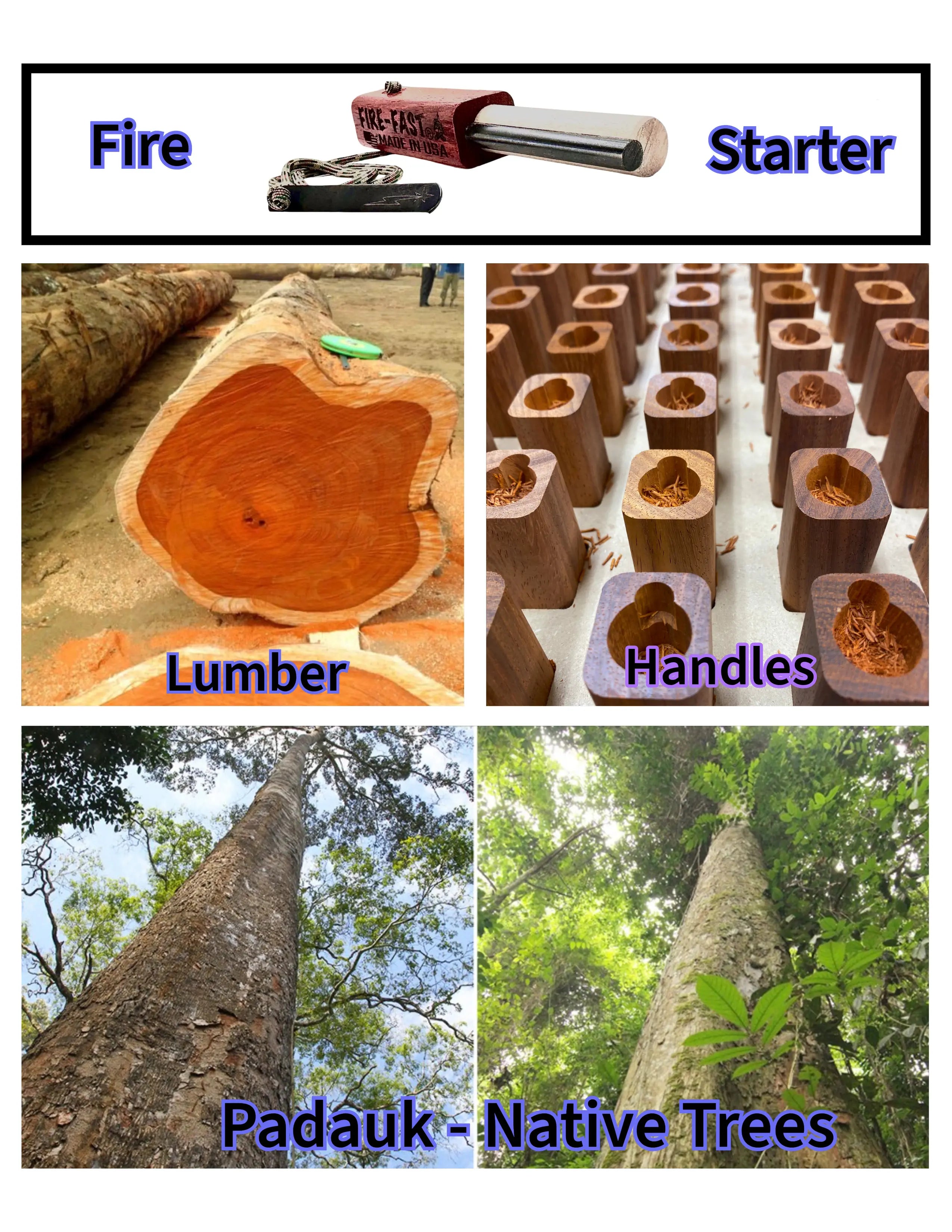
The handles on Fire-Fast fire starters are made from African Padauk (Pterocarpus soyauxii), a dense tropical hardwood from Central and West Africa. We chose it for three practical reasons that matter in the field:
- It scrapes into usable tinder
- It is naturally water-resistant
- It does not shatter when dropped
Here’s the deeper technical side of why those traits exist.
What Padauk Actually Is
African Padauk is a moderately heavy hardwood. Typical air-dried density sits around 46–47 lbs per cubic foot (about 745–790 kg/m³). Its Janka hardness is roughly 1,710–1,970 lbf, which places it harder than hard maple and significantly harder than most common North American hardwoods used for tool handles.
The wood is rated very durable against decay fungi and is resistant to termites. European standards place the heartwood in Use Class 4 (suitable for ground contact or fresh-water exposure) without chemical treatment.
Why It Resists Water
Padauk contains a high percentage of natural extractives — roughly 13% or more of its dry weight. These resins, oils, and red pigments (including compounds such as santalin) make the wood naturally water-repellent. The extractives fill the cell structure and slow moisture uptake dramatically compared with ordinary woods.
This is why a Padauk handle stays relatively stable and functional even after repeated wetting and drying cycles in the field.
Scraping for Tinder
Because of its density and the way the grain fractures under a sharp edge, Padauk can be scraped into fine, fibrous shavings that will take a spark. It is not as soft or as resin-rich as fatwood, but it produces usable emergency tinder when other options are scarce. The same toughness that keeps the handle from breaking also gives it enough structure to hold a clean scrape.
Toughness and Drop Resistance
Padauk combines high strength with good dimensional stability (low shrinkage and movement). The combination of density, interlocking grain in many pieces, and natural oils produces a handle that absorbs shock rather than fracturing cleanly the way more brittle woods can. In practical terms, it survives the kind of accidental drops and impacts that destroy lighter or more open-grained woods.
Color and Aging
Freshly cut Padauk is a vivid orange-red to deep coral. Over time, and especially with UV exposure, it darkens to a rich reddish-brown or purplish-brown. The color change is purely cosmetic and does not affect the mechanical properties or water resistance.
Traditional Uses
In its native range the wood has long been used for tool handles, knife handles, canoes, walking sticks, and outdoor joinery precisely because of the combination of durability, toughness, and natural weather resistance we rely on.
Where the Wood Comes From and How It Reaches Us
African Padauk grows in the tropical forests of the Congo Basin — primarily Gabon, Cameroon, the Republic of Congo, and the Democratic Republic of Congo.
The typical trade path for the higher grades used in tool handles runs roughly:
Africa → Europe → North America (often via Canada)
Material leaves African ports (mainly Douala, Kribi, Owendo, and Pointe-Noire), frequently passes through European hubs such as Antwerp for inspection, grading, and sometimes further processing, then continues to Canadian or U.S. importers. This route developed historically because European trading houses long controlled much of the African tropical timber trade, and it remains economically practical due to established shipping lines and distribution networks.
A Brief Commercial History
Padauk first entered international commerce in large volumes during the 19th century — not primarily as timber, but as a dyewood. Heartwood was exported from Cameroon and Gabon to Europe and North America under the names “barwood” or “camwood.” It was used to produce durable red dyes for wool and cotton cloth (especially popular for printed bandanas in England). Dye use continued into the early 20th century. Only later did the wood itself become widely valued for its strength, stability, and appearance in tool handles and other demanding applications.
Sustainability
African populations of Pterocarpus soyauxii have been listed in CITES Appendix II since 2023, so international trade is regulated. In the main producing countries, harvesting is controlled through minimum diameter limits, annual quotas, and forest management plans. Natural regeneration is generally good within managed concessions, and some concessions also practice assisted regeneration. While illegal logging remains a regional concern, the species is not currently regarded as critically endangered when harvested under regulated systems.
Fire-Fast: Why we use this hardwood
Fire-Fast deliberately sources higher-grade African Padauk that has passed through this multi-stage international selection process. We spare no cost in obtaining the finest materials from around the world when they deliver measurable performance advantages in the finished fire starter.
This is the third of five “Geek Details” posts. Next up will continue exploring the key materials that make a Fire-Fast fire starter work the way it does.
If you’re the kind of person who likes knowing exactly what’s in the tools you carry, welcome to the club.

Written by Peter Van Der Meulen


Leave a comment
This site is protected by hCaptcha and the hCaptcha Privacy Policy and Terms of Service apply.