
Geek Details - Fire-Fast Fire Starters – Magnesium
Here is some information that most of you don’t want to know. It’s the geeky, in-depth stuff that bores the majority of folks but is appreciated by a few. Enjoy!
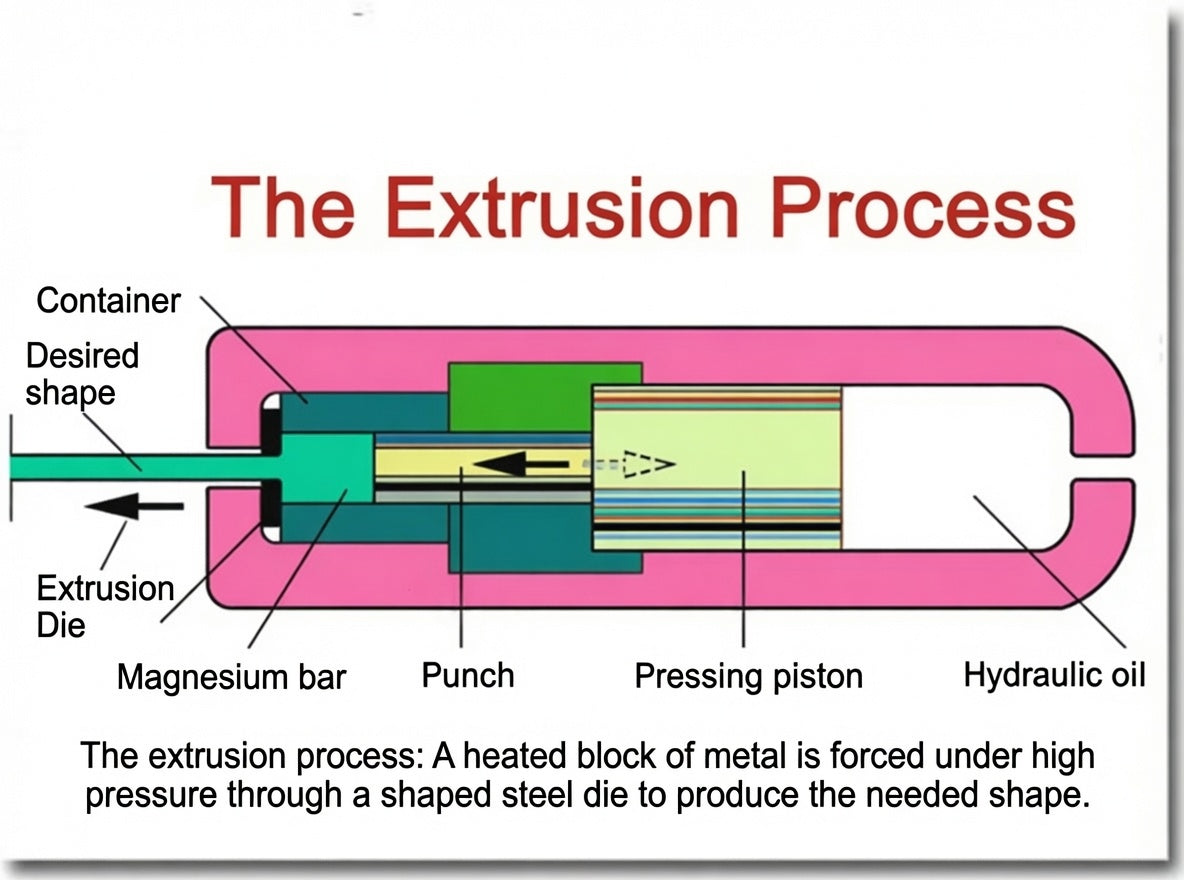
Most people see a silver rectangular block with a ferro rod glued to the side and simply call it a “magnesium fire starter.” In reality, the material used in the vast majority of commercial fire starters is quite different from high-purity or aerospace-grade magnesium — both in composition and in how it is manufactured.
Casting vs. Extrusion / Machining
Magnesium alloys fall into two broad industrial categories:
- Casting alloys — Higher aluminum content (typically 6–9 %). The most common example is AZ91D (approximately 90 % magnesium, 9 % aluminum, 1 % zinc). These alloys have excellent fluidity when molten and are designed for high-volume die casting. Tooling is relatively inexpensive and production rates are high, which keeps unit cost low.
- Wrought alloys — Lower aluminum content (typically around 3 %). The classic example is AZ31B (approximately 96 % magnesium, 3 % aluminum, 1 % zinc). These alloys are primarily extruded, rolled, or machined. They are not normally die-cast into finished shapes because of poorer castability and a greater tendency to oxidize or ignite during melting.
The practical dividing line in industry is largely driven by aluminum content. Alloys with higher aluminum (AZ91 family and similar) are optimized for casting. Alloys with lower aluminum (AZ31 family and similar) are optimized for extrusion and machining.
Why Most Fire-Starter Blocks Are ~90 % Magnesium (AZ91-type)
The rectangular magnesium blocks commonly sold as fire starters are almost always cast material in the AZ91 family (roughly 90 % magnesium). Casting allows high-volume, low-cost production. Extrusion of higher-purity material is significantly more expensive on a per-unit basis, especially in the relatively small volumes needed for consumer fire starters.
Practical Comparison: 90 % vs 96 % Magnesium
| Category | ~90 % Magnesium (AZ91-type) | ~96 % Magnesium (AZ31B-type) |
|---|---|---|
| Common Designation | AZ91D (or similar cast alloys) | AZ31B |
| Manufacturing Method | Cast (poured into molds) | Extruded or machined |
| Scraping Behavior | Hard chips or powder | Continuous spiral shavings |
| Time to produce ¼-sized pile | ~20 minutes | 10–15 seconds |
| Ease of Scraping | Difficult | Easy |
| Ease of Ignition (shavings) | Harder to ignite cleanly | Ignites readily |
| Typical Use in Fire Starters | Most common commercial blocks | Higher-performance / premium rods |
Safety Note: Safe to Carry… Until You Shave It
A solid magnesium bar or rod is remarkably stable and safe to carry in a pocket, pack, or survival kit. It will not spontaneously ignite under normal conditions.
Once you scrape it into fine shavings or powder, however, the material changes character. The high surface area turns it into a highly reactive substance — essentially haz-mat. That is exactly why it works so well as a fire starter. When you need to light a fire in difficult conditions, that sudden jump in reactivity is a feature, not a bug. Just treat the shavings with respect: keep them in a small controlled pile, and be ready to transfer the flame to your tinder quickly.
Ignition Temperature: Solid Bar vs. Shavings
Ignition temperature is strongly affected by surface area:
- A solid bar of pure or high-purity magnesium has an ignition temperature close to its melting point — roughly 1,165–1,200 °F (630–650 °C). Large pieces are relatively difficult to ignite.
- Fine shavings or powder have far higher surface area, so their ignition temperature drops dramatically — often into the 900–1,020 °F (480–550 °C) range or lower, depending on particle size.
Higher-purity material (96 %) produces fine spiral shavings more easily, and those shavings ignite more readily. The lower-purity cast alloys (90 %) require far more effort to produce usable material and that material is less eager to catch.
Why Magnesium Is Tricky to Melt and Alloy
Pure magnesium has an awkward problem: it starts to catch fire at about 1,165 °F, but it doesn’t actually melt until 1,200 °F. In other words, it can begin burning before it has even turned into a liquid.
If you simply try to heat a chunk of pure magnesium in open air, it often ignites and burns instead of melting cleanly. This is true of 96% magnesium also.
How manufacturers solve this
They reverse the order of operations:
- They melt the aluminum first. Aluminum melts at a slightly higher temperature and is much more stable — it doesn’t try to catch fire the same way.
- Once they have a liquid pool of molten aluminum, they carefully add the magnesium pieces into that pool.
- At the same time they cover the surface with a protective flux (a special powder) or an inert gas (like argon). This keeps oxygen away from the magnesium.
Because the magnesium is dropped into already-molten aluminum and is shielded from air, it dissolves into the liquid metal instead of sitting on the surface and catching fire. Once it is fully mixed in, the resulting alloy behaves much more predictably.
That is the practical reason the process works: the magnesium never gets the chance to burn in open air because it is immediately absorbed into the aluminum bath under protection.
Where Magnesium Comes From
Magnesium is the eighth-most abundant element in the Earth’s crust. The two main commercial production routes are:
- Electrolytic process (historically the Dow process) — magnesium chloride from seawater or brine is electrolyzed.
- Thermal (Pidgeon) process — dolomite is calcined and reduced with ferrosilicon under vacuum. This process currently dominates global production.
This is the second of five “Geek Details” posts. Next up will continue exploring the key materials that make a Fire-Fast fire starter work the way it does.
If you’re the kind of person who likes knowing exactly what’s in the tools you carry, welcome to the club.

Written by Peter Van Der Meulen


Leave a comment
This site is protected by hCaptcha and the hCaptcha Privacy Policy and Terms of Service apply.