
Geek Details: Fire-Fast Fire Starters – Ferrocerium
Here is some information that most of you don’t want to know. It’s the geeky, in-depth stuff that bores the majority of folks but is appreciated by a few. Enjoy!
The heart of every Fire-Fast fire starter is the ferrocerium rod (often just called the “ferro rod” or “flint”). Most people never think twice about what that little rod actually is. Let’s dig into the real history.
Carl Auer von Welsbach and the Birth of Ferrocerium
In 1903 the Austrian chemist and inventor Carl Auer von Welsbach (1858–1929) patented a pyrophoric alloy he called Auermetall (Auer metal). The common English name that stuck is ferrocerium — from Latin ferrum (iron) and the rare-earth element cerium.
View historical portrait of Carl Auer von Welsbach (1910)
Auer von Welsbach was already famous for two earlier inventions: the gas mantle (the “Auer light”) that made gas street lighting practical, and early metal-filament electric lamps. While working with rare-earth residues left over from thorium production for those gas mantles, he discovered that an alloy of cerium and iron produced an intense shower of hot sparks when scraped.
His original patented composition was roughly 70 % cerium (and related rare earths) + 30 % iron. He later refined three versions:
- Auermetall I – relatively pure cerium + iron
- Auermetall II – cerium-iron enriched with lanthanum (brighter sparks, intended for signaling)
- Auermetall III (also called “Erdmetall”) – iron alloyed with the natural mixture of rare-earth metals (mischmetal). This was the practical, lower-cost version that won the market.
Only the third version became the worldwide standard for lighter flints and, later, outdoor fire steels.
The Austrian Factory in Althofen / Treibach
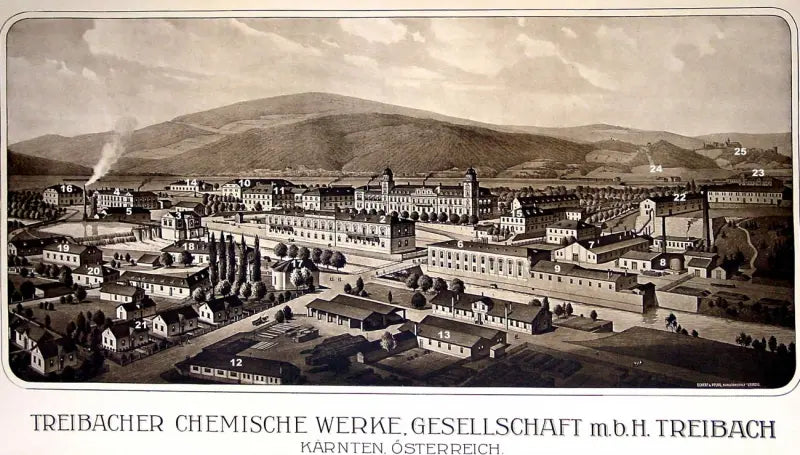
In 1907 Auer von Welsbach founded Treibacher Chemische Werke GesmbH (today Treibacher Industrie AG) in the small town of Treibach-Althofen in Carinthia, Austria. He converted an old ironworks into a chemical plant specifically to produce ferrocerium flints under the brand “Original Auermetall.”
View the Treibacher works in Althofen
That same company (and the same location) has been making ferrocerium continuously for well over a century. The town still hosts the Auer von Welsbach Museum, which preserves his laboratory equipment, original samples, and documents.
Early Uses and Arrival in the United States
The first commercial products were pocket lighters and “sparkers” that replaced the old flint-and-steel method. By the 1910s ferrocerium flints were appearing in cigarette lighters across Europe. American companies quickly adopted the material; Ronson (Art Metal Works) was one of the early U.S. makers that used it extensively.
During World War I and especially World War II, ferrocerium rods became standard issue in military survival kits because they work when wet and produce sparks hot enough to ignite tinder even in difficult conditions. The same reliability is why modern outdoor and survival ferro rods still rely on the same basic principle Auer developed.
Quirky Details
- Auer von Welsbach coined (or at least popularized) the term “pyrophoric” for the sparking behavior of these alloys.
- The original patent was contested in several countries, but he successfully defended it.
- Early production used the waste residues from his own gas-mantle factories — turning an industrial by-product into a new product.
- The sparks from ferrocerium reach temperatures around 3,000 °C (about 5,400 °F) — far hotter than the sparks from traditional flint and steel.
- The basic mischmetal + iron principle Auer developed more than a century ago remains the foundation of ferrocerium. However, the actual composition, hardness, and performance of rods available today can vary dramatically depending on the source and formulation.
Further Reading & Sources
- Wikipedia entry for “Ferrocerium” and “Carl Auer von Welsbach”
- The Auer von Welsbach Museum site (Althofen)
- U.S. Patent US837017A (1906) – Auer’s “Pyrophoric Alloy” patent
- Carl Auer von Welsbach: Chemist, Inventor, Entrepreneur (Adunka & Orna)
This is the first of five “Geek Details” posts. Next up will dig into the other key components that make a Fire-Fast fire starter perform the way it does.
If you’re the kind of person who likes knowing exactly what’s in the tools you carry, welcome to the club.

Written by Peter Van Der Meulen




Leave a comment
This site is protected by hCaptcha and the hCaptcha Privacy Policy and Terms of Service apply.